Quick answer: A whole house fan pulls cold, fresh outdoor air inside your home through open windows and pushes hot indoor air out through your attic vents. If you run it for 20 to 30 minutes, you can drop indoor temperatures by 10 to 20 degrees.
You know the feeling – It’s 3 p.m., the AC has been running since noon, and your house still feels warm. Before you lower the thermostat again and watch your energy bill climb, it may be time to consider a more efficient cooling option. It’s called a whole house fan. It quickly removes built-up heat from your home while using far less energy than traditional air conditioning, letting homeowners stay comfortable.
Let’s walk through exactly how a whole house fan works, its benefits, costs, and how to get the most out of it once it’s installed.
What Is a Whole House Fan?
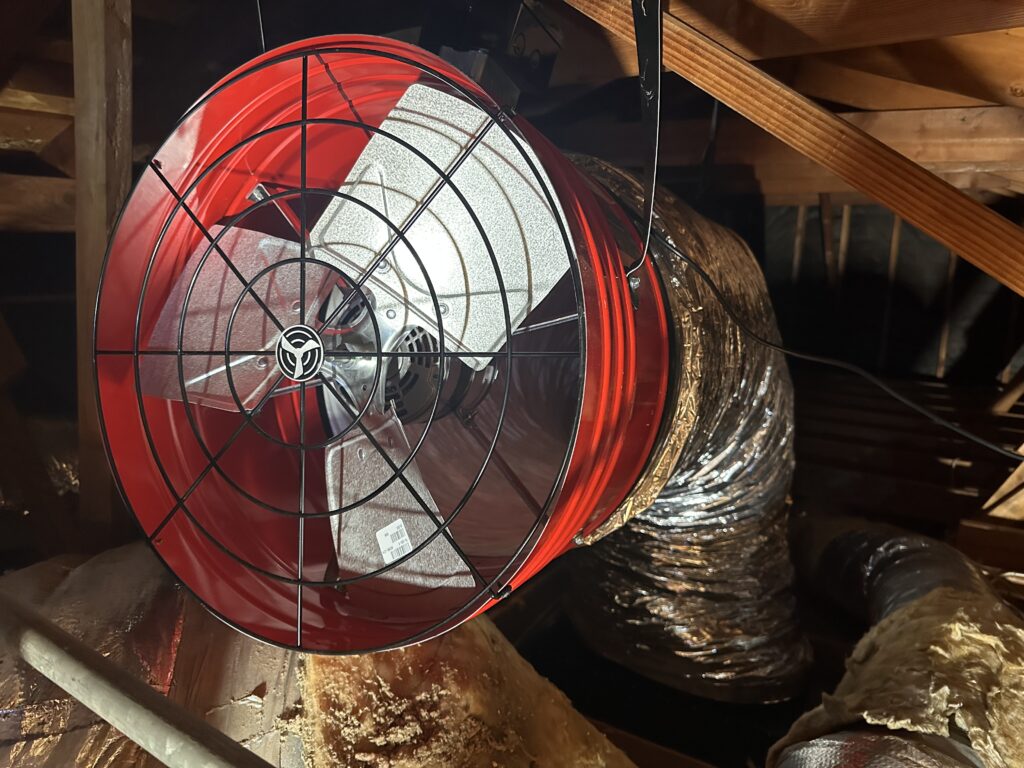
A whole house fan is a large fan mounted in your ceiling, usually somewhere central like a hallway, that connects your living space directly to your attic. Flip it on and it pulls air out of every room in the house, sends it up into the attic, and pushes it out through the roof or gable vents.
Think of it as a cooling system for your entire home rather than a single room. While ceiling fans and portable fans simply circulate the air already inside, a whole house fan replaces hot indoor air with cooler outdoor air. This creates a steady flow of fresh air that can cool your home much faster during cooler mornings and evenings.
Most systems are installed in a central location where they can move air efficiently throughout the house. Proper sizing is one of the most important parts of the installation process. A fan that is too small may not provide enough airflow, while one that is too large can be inefficient and noisy. Professional whole house fan installation services handle that sizing for you, so you don’t end up with a fan too weak to actually do the job.
Benefits of a Whole House Fan
Energy savings get all the attention, and fair enough, since they’re significant. But that’s only part of the story. A whole house fan also clears out stale air, costs next to nothing to maintain, and trims your home’s carbon footprint without you having to think about it.
- Uses up to 90% less energy than AC. A whole house fan pulls 200 to 700 watts, while central AC pulls 3,000 to 5,000. Run the math on a summer electric bill and the difference isn’t subtle.
- Improves indoor air quality. Old, stale indoor air gets swapped for fresh air from outside, which helps clear out odors, dust, and trapped humidity.
- Reduces carbon footprint. Using less power means fewer emissions tied to keeping your home comfortable. It’s a small thing on its own, but it adds up over a summer.
- Lower maintenance costs. There’s no refrigerant, no filters to replace, and none of the annual tune-up routine an AC system needs.
One more perk worth mentioning: the less your AC runs, the less wear it takes on. That can buy you a few extra years before you’re shopping for a replacement system.
How Does a Whole House Fan Work? (Step-by-Step)
Open some windows, flip the switch, and let the fan do the work. Cool air comes in, hot air gets pushed out through the attic, and most homes feel a noticeable difference within half an hour. Here’s how.
Step 1: Open windows in the rooms you want to cool.
You don’t need to throw open every window in the house. Cracking two to four windows a few inches, especially in the rooms you actually use, is usually plenty.
Step 2: Turn on the fan.
Most fans today run off a wall switch or remote, and if you’ve got a QuietCool system like the ones we install, you can run it straight from an app on your phone. That app also lets you set timers and check the attic temperature.
Step 3: Cool air gets pulled in while hot air gets pushed out.
The fan draws outdoor air through your open windows, moves it through the house, and pushes the warm air it displaces up into the attic and out through the vents. It’s simple physics, really.
Step 4: Close the windows once the temperature drops.
Give it 20 to 30 minutes. Once the house feels good, shut the windows and turn the fan off to trap that cooler air inside.
| That’s the whole cycle, but here’s the catch: it only works as well as your attic lets it. If there isn’t enough ventilation up there to let the hot air escape, the fan ends up fighting an uphill battle no matter how strong it is. |
Whole House Fan vs. Attic Fan: What’s the Difference?
A whole house fan cools your entire home but an attic fan only cools the attic. People mix these up constantly, and it’s an easy mistake to make since both names sound almost identical.
An attic fan stays in the attic and does one job: pull hot air out of that space so it doesn’t bake your roof and bleed heat into the rooms below. It never touches the air in your living room or bedrooms, and you don’t need to crack a single window for it to run.
A whole house fan works differently. It sits between your living space and the attic and actively trades the air inside your home for air from outside. Here’s a quick comparison:
| Feature | Whole House Fan | Attic Fan |
| What it cools | Entire living space | Attic only |
| Windows required | Yes, cracked open | No |
| Installation location | Hallway or top-floor ceiling | Roof or gable vent |
| Best use case | Replacing hot indoor air fast | Keeping attic and roof from overheating |
| Energy use | Low (200–700 watts) | Very low |
A lot of homes actually do better with both running together. We offer attic fan installation alongside whole house fan systems for exactly that reason: one keeps the attic in check, and the other keeps the living space cool.
Whole House Fan vs. Air Conditioner
Let’s be clear about something — a whole house fan doesn’t replace your AC. It just means your AC doesn’t have to work nearly as hard.
Air conditioning cools and dehumidifies through refrigeration, so it can bring your home down to whatever temperature you set, no matter what’s happening outside. A whole house fan only works when outdoor air is cooler than indoor air, which usually means early morning or evening during summer.
That timing happens to fit Central Valley perfectly, since even during a brutal heat wave, our mornings cool off. Run the fan then to flush out the overnight heat buildup, save the AC for the worst hours of the afternoon, and your total cooling cost drops noticeably compared to running central air all day long.
How to Use a Whole House Fan Effectively: Do’s and Don’ts
Timing is everything here. Run the fan when it’s cooler outside than inside and you’ll feel results almost immediately. Get the timing backward and you’ll wonder why you bothered installing one.
Do:
- Run it early morning or evening, when outdoor air is cooler than indoor air
- Open windows in the rooms you most want cooled
- Shut doors to rooms you’d rather not pull air through
- Keep attic vents clear so the air has somewhere to go
Don’t:
- Run it midday, when it’s hotter outside than in
- Leave every window shut, since the fan needs air to pull from somewhere
- Rely on it instead of AC during extreme heat, 105°F and up
- Ignore a poorly ventilated attic, since it’ll choke the fan’s performance
Get these basics right and a whole house fan genuinely changes how your home feels in summer. Get them wrong, and it’s just an expensive ceiling fixture that never lives up to what it could do.
How to Install a Whole House Fan
Here’s roughly how it goes:
- Placement. The fan typically goes in a top-floor hallway ceiling, central enough to pull air evenly from the surrounding rooms.
- Ceiling cutting and framing. The opening gets cut and framed carefully to keep the ceiling structurally sound. Rush this step and you risk sagging or damage down the road.
- Electrical wiring. This is handled by a licensed electrician, to code, and it’s not a step to take on yourself. Bad wiring here is a real fire risk.
- Attic venting check. DOE guidance calls for enough net free vent area to let the fan’s airflow escape without resistance. Skimp on venting and the fan works harder for a weaker result.
- Testing and walkthrough. Once it’s installed, we test it and walk you through how to run it for the best results.
Given the structural and electrical work involved, this really isn’t a weekend DIY project. Get the sizing or wiring wrong and you could void a warranty or create a genuine safety hazard. We handle the whole process start to finish, and we’ll usually check your attic insulation while we’re up there too, since the two work hand in hand for year-round performance.
Ready to Cool Your Home the Smart Way?
A whole house fan is one of the cheapest, most effective upgrades you can make for a Central Valley summer, as long as the sizing, placement, and attic ventilation are done right from day one. Tyson Insulation is a licensed home insulation and whole house fan contractor serving Fresno, Visalia, Tulare, and the greater Central Valley.
Schedule a free estimate with Tyson Insulation or call 559-754-7095, and let’s get a system built for your home.
Frequently Asked Questions About Whole House Fans
Do whole house fans really work?
Yes. They can drop indoor temperatures 10 to 20 degrees in 20 to 30 minutes, using a fraction of the power central AC uses. They work best when it’s cooler outside than in, so mornings and evenings are prime time to run one.
How Much Does a Whole House Fan Installation Cost?
Expect somewhere between $1,200 and $3,500 for a full installation, depending on your home’s size, the fan you choose, and how much electrical or attic work is involved. If new wiring is needed, add another $150 to $400 for electrical labor.
Can I use a whole house fan with my AC?
Yes, and plenty of homeowners do exactly that. Run the fan during the cooler hours to clear out heat, then switch over to AC once it gets brutal outside. That combination means less AC runtime and a lower bill.
How many air changes per hour does a whole house fan provide?
A correctly sized unit typically swaps out all the air in your home every two to three minutes, which works out to roughly 20 to 30 air changes per hour. That’s a lot more turnover than you’d get from open windows alone.
How long does a whole house fan last?
Most whole house fans last 15 to 20 years with reasonable care. How long yours actually lasts depends on how often you use it, the quality of the unit, and whether it was sized and installed correctly to begin with.
Are whole house fans noisy?
Older units could be loud, but modern systems, QuietCool included, are built to run quietly. Most people compare the sound to a ceiling fan on its higher setting, nothing more.
Is a whole house fan worth it in California?
Yes, and especially in the Central Valley, where hot afternoons can reach up to 100 degrees. That swing is exactly the condition a whole house fan needs to perform at its best.